
Defining Egg Freezing: Empowering Fertility Choices

Finding real options for future family building can feel urgent when you notice changes in your fertility. If you are in your late 30s or early 40s and concerned about diminished ovarian reserve, the science of egg freezing now gives you tools that never existed for past generations. This guide explains how modern technology allows you to preserve egg quality before age leads to further decline, outlining the process, technology, and essential facts you need to confidently weigh your next steps.
Table of Contents
Key Takeaways
Point | Details |
Egg Freezing Process | Egg freezing involves ovarian stimulation, egg retrieval, and vitrification to preserve egg quality for future use. Understanding each phase helps in managing expectations and logistics. |
Financial Considerations | The cost of egg freezing can range from USD 12,000 to USD 18,000 per cycle, with additional annual storage fees and IVF costs. Evaluating insurance coverage is crucial to avoid unexpected financial burdens. |
Success Rates | Success rates for pregnancy are largely determined by age at freezing, with higher viability for eggs frozen before age 35. It’s essential to assess personal health metrics to set realistic expectations. |
Medical and Psychological Risks | While risks like ovarian hyperstimulation syndrome exist, the emotional and financial stress surrounding the process can be significant. A thorough understanding of all aspects is essential before proceeding. |
What Is Egg Freezing And How It Works
Egg freezing is a fertility preservation method that allows women to collect their eggs, freeze them, and store them for future use when they’re ready to pursue pregnancy. This process works by extracting mature eggs from your ovaries, preserving them in their current state, and thawing them later for fertilization when you decide the time is right. For women in their late 30s and 40s facing diminished ovarian reserve, this technology offers a practical way to work against the natural decline in egg quality that comes with age. The fundamental appeal is straightforward: you capture your eggs at a time when their quality is higher, then use them later regardless of how much time passes.
The egg freezing process unfolds across several distinct phases. It begins with ovarian stimulation, where you receive hormone injections for 8 to 11 days to encourage your ovaries to produce multiple mature eggs rather than the single egg your body typically releases each month. During this stimulation period, your fertility specialist monitors your progress through regular ultrasound scans and blood tests to track hormone levels and follicle development. Once your eggs reach optimal maturity, you undergo egg retrieval, a minimally invasive surgical procedure performed under sedation where a specialized needle guides by ultrasound extracts the eggs directly from your ovaries. The entire retrieval typically takes 15 to 20 minutes, and most women return to normal activities within a few days.
Once collected, your eggs move into the freezing stage, where they undergo vitrification, a rapid-freezing technique that preserves egg structure and quality far better than older slow-freezing methods. The eggs are then stored in liquid nitrogen at extremely low temperatures, where they can remain viable for many years. When you’re ready to use your frozen eggs, they are thawed, fertilized through conventional IVF or intracytoplasmic sperm injection (ICSI), and the resulting embryos develop for several days before transfer into your uterus. Research shows that 10 to 15 frozen eggs provide reasonable odds of achieving at least one successful pregnancy, though outcomes depend significantly on your age at the time of freezing and overall egg quality.
The real advantage of this approach becomes clear when you understand the biological reality: egg quality declines steadily after age 35, with the steepest drops occurring in your late 30s and 40s. By freezing eggs now, you essentially put your fertility on pause, preserving the genetic material in its current state. This matters enormously if you’re navigating career decisions, relationship timing, or health concerns that make pregnancy impractical today but potentially appealing in future years.
Pro tip: Start the consultation process well before you’re ready to freeze; understanding your ovarian reserve and egg quality through testing like an antral follicle count and AMH blood work helps you make an informed decision about timing and realistic outcome expectations.
Types Of Egg Freezing Technologies Today
When you’re considering egg freezing, understanding the technologies behind the process matters more than you might think. The freezing method directly impacts how well your eggs survive the thawing process and whether they’ll be viable for fertilization months or years later. Today, the fertility field has moved decisively toward one dominant technology, but knowing the alternatives and why one emerged as the clear winner helps you ask informed questions during your consultation.
Vitrification has become the standard approach used across fertility clinics worldwide. This ultra-rapid freezing technique works by cooling your eggs so quickly that water molecules don’t have time to form harmful ice crystals, which was the major problem with older methods. The speed matters tremendously. Instead of taking hours to freeze (the old way), vitrification freezes eggs in seconds, essentially turning the liquid surrounding your egg into a glass-like solid without crystalline damage. This breakthrough technology has transformed egg freezing from a questionable option into a genuinely effective fertility preservation strategy. Your eggs are then stored in liquid nitrogen at temperatures around negative 320 degrees Fahrenheit, where they can remain viable for many years without degradation.
The older slow freezing method still exists in some clinics, but it’s becoming increasingly rare. This gradual cooling process, which took several hours, allowed ice crystals to form inside and around eggs, damaging their cellular structure. Egg survival rates with slow freezing were significantly lower, typically around 50 percent, whereas vitrification achieves survival rates above 90 percent. For women with diminished ovarian reserve in their late 30s and 40s, this difference is enormous. You’re already working with fewer eggs, so losing half of them to freezing damage is a loss you cannot afford. Most modern fertility centers have abandoned slow freezing entirely in favor of vitrification.
Beyond these primary technologies, researchers continue developing emerging approaches. Ovarian tissue freezing and in-vitro maturation show promise for future applications, particularly for women who need to preserve fertility urgently before cancer treatment or other medical interventions. However, these remain experimental. Advanced cryoprotectants and ovarian stimulation protocols continue to improve outcomes, but vitrification remains the most established, successful, and widely available method. When evaluating clinics, ask specifically whether they use vitrification and what their egg survival rates are post-thaw. These numbers tell you everything about their technical competency.
Here’s a quick comparison of egg freezing technologies and their effectiveness:
Method | Freezing Speed | Egg Survival Rate | Common Use Today |
Vitrification | Seconds (very rapid) | Above 90 percent | Global standard |
Slow Freezing | Several hours (slow) | Around 50 percent | Rare, mostly outdated |
Ovarian Tissue Freezing | Variable, depends on process | Experimental, data limited | Primarily research use |
In-Vitro Maturation | Depends on protocol | Still experimental | Limited, special cases |
Pro tip: Request your clinic’s specific egg survival and fertilization rates following vitrification and thawing, not just their overall pregnancy success rates, because these metrics directly reflect the quality of their freezing technology and technique.
Step-By-Step Egg Freezing Process Explained
The egg freezing journey typically unfolds over two to three weeks, though the emotional and practical investment extends far beyond those calendar days. Understanding each phase helps you know what to expect physically, mentally, and logistically. This is not a procedure you simply show up for on a single day. Rather, it demands coordination, careful medication adherence, and multiple clinic appointments spread across several weeks.
Phase One: Consultation and Baseline Testing begins before any medications enter your system. During your initial consultation, your fertility specialist reviews your medical history, current health status, and reproductive goals. You undergo baseline testing including blood work to measure hormone levels and antral follicle counts via ultrasound to assess your ovarian reserve. This evaluation determines whether egg freezing is appropriate for you and helps predict how many eggs you might retrieve. Infection screening happens during this phase as well. This foundational step takes roughly one to two weeks and gives you concrete data about your fertility status.
Phase Two: Ovarian Stimulation is where the active part begins. You receive injectable hormones for 8 to 12 days designed to encourage your ovaries to produce multiple mature eggs simultaneously rather than the single egg your body naturally releases each month. These injections are typically self-administered at home, often in the abdomen or thigh, and most women adapt to the routine within a few days. Throughout this stimulation window, you attend regular monitoring appointments where blood tests measure hormone levels and transvaginal ultrasounds track follicle development. Your clinic adjusts medication doses based on these results to optimize egg maturation. Many women report that this phase, while requiring discipline around injection timing and frequent appointments, feels manageable once they establish a routine.

Phase Three: Trigger Shot and Egg Retrieval arrives once your follicles reach optimal size. Your clinic administers a trigger injection approximately 35 to 36 hours before retrieval to induce final egg maturation. The retrieval itself is performed under sedation using an ultrasound-guided needle inserted through the vaginal wall to access your ovaries and gently aspirate mature eggs. The entire procedure typically takes 15 to 20 minutes, and you recover within a few hours. Most women experience mild cramping afterward and return to light activity within one to two days.
Phase Four: Freezing and Storage happens immediately after retrieval. Your mature eggs undergo vitrification, the rapid-freezing process that preserves them in suspended animation. They’re then stored in liquid nitrogen tanks at your fertility clinic, where they can remain viable for many years. Your clinic provides detailed documentation about your frozen eggs and storage arrangements. This phase requires no action from you except maintaining contact with your clinic and staying informed about storage protocols and any policy changes.
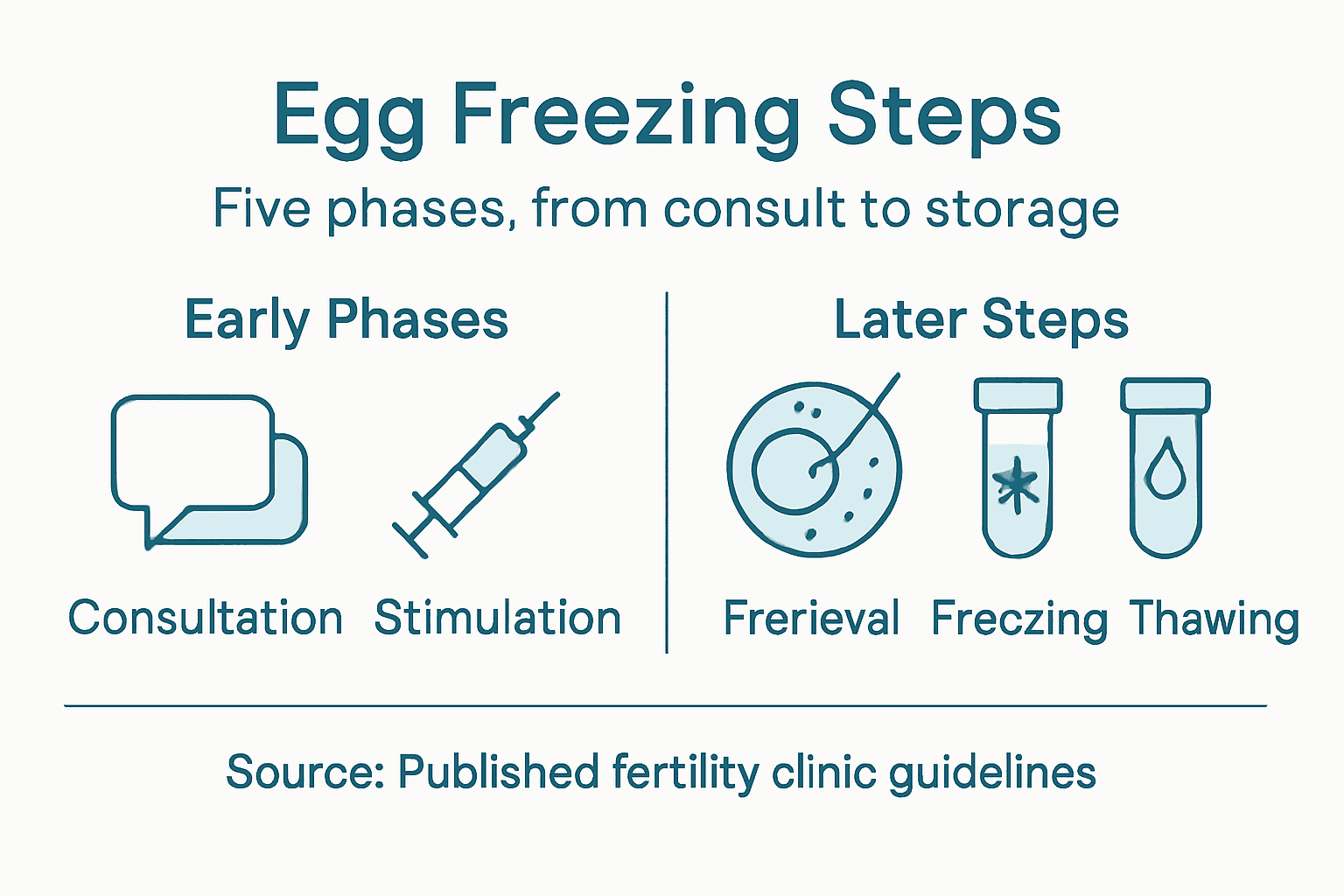
Phase Five: Thawing and Fertilization occurs whenever you’re ready to use your eggs, whether that’s months or years later. When you decide to proceed with pregnancy, your frozen eggs are carefully thawed, assessed for viability, and fertilized using conventional IVF or intracytoplasmic sperm injection (ICSI) with your partner’s or donor sperm. Embryos develop in the laboratory for five to six days before one is transferred into your uterus, with any high-quality remaining embryos frozen for future use.
Pro tip: Keep detailed records of all your appointments, medications, and clinic communications throughout the process, and maintain a calendar showing exactly when you need to administer injections, as missing doses or timing them incorrectly significantly impacts the number and quality of eggs retrieved.
Global Costs And Financial Factors In 2026
The financial reality of egg freezing stops many women from pursuing it, even when the procedure aligns perfectly with their fertility goals and timeline. The global egg freezing market demonstrates the scale of this challenge. In 2026, the global egg freezing service market reached approximately USD 4.24 billion, reflecting growing demand driven by career priorities, delayed childbearing, and medical necessity. Yet this massive market value masks a troubling truth: costs remain prohibitively high for most women, particularly those without robust insurance coverage or employer benefits.
The expenses stack up across multiple categories. The egg retrieval cycle itself, including hormone treatments and the surgical procedure, typically ranges from USD 12,000 to USD 18,000 per cycle in the United States, depending on your location and clinic. But that is only the beginning. Annual storage fees for frozen eggs add another USD 500 to USD 1,500 yearly, costs that compound over time if you freeze eggs in your early 40s and don’t use them for several years. If you require multiple egg freezing cycles because your first retrieval yields fewer eggs than hoped, those expenses double or triple. For women with diminished ovarian reserve, this multiplier effect can mean USD 50,000 or more in out-of-pocket spending before a single embryo transfer occurs. When you add the cost of IVF itself (USD 15,000 to USD 25,000 per cycle), the total investment becomes daunting.
The burden falls disproportionately on women without employer-sponsored fertility benefits. Large corporations increasingly offer egg freezing coverage as part of their reproductive health packages, covering anywhere from 50 to 100 percent of costs. However, self-employed women, those working for smaller companies, and women in countries with minimal public health support face the full financial weight alone. Geographic variation compounds this inequality. Costs in Europe, Australia, and Canada often run 20 to 40 percent lower than United States pricing due to different healthcare systems and regulatory structures. Women in developing economies may have access to cheaper procedures but face questions about clinic quality and technology standards. Government initiatives in some regions, particularly in Scandinavian countries and parts of Asia, subsidize egg freezing for medical reasons, but coverage for elective fertility preservation remains rare globally.
Looking forward, the market is projected to grow to nearly USD 9.9 billion by 2032, driven by rising infertility awareness and advances in cryopreservation technology. This growth should theoretically increase competition and lower costs through economies of scale. However, that benefit only materializes if regulatory barriers fall and insurance coverage expands. Without systemic change, growing market value may simply reflect more women paying more money, not prices becoming more accessible. Public and private funding initiatives are beginning to shift the landscape, particularly in Europe and parts of North America, but meaningful affordability remains years away for most women globally.
Below is a summary of main egg freezing costs and influencing factors globally:
Cost Factor | Typical Range (USD) | Influences |
Retrieval Cycle | $12,000 – $18,000 per cycle | Clinic, location, protocol |
Annual Storage Fees | $500 – $1,500 per year | Clinic, length of storage |
IVF Cycle (if needed) | $15,000 – $25,000 per cycle | Fertility meds, clinic, add-ons |
Insurance/Employer Aid | 50% – 100% of costs (varies) | Company size, region, benefits |
International Pricing | 20% – 40% lower outside U.S. | Health system, regulation |
Pro tip: Before committing financially, request a detailed cost breakdown from your clinic including all fees for stimulation, retrieval, anesthesia, and storage, then check whether your health insurance or employer offers any fertility benefits, as coverage varies enormously and some plans cover 50 to 100 percent of costs.
Risks, Success Rates, And Key Considerations
Egg freezing is not risk-free, and that reality matters before you commit emotionally or financially to the process. Medical risks exist alongside psychological and financial burdens that deserve honest discussion. Understanding both the genuine dangers and the realistic outcomes helps you make an informed decision rather than entering the procedure with unrealistic expectations or unacknowledged concerns. Your age at the time of freezing is the single most important variable determining success, but it is far from the only factor worth considering.
Medical risks from egg freezing are generally modest but real. During the ovarian stimulation phase, your ovaries produce more hormones than usual, which can trigger ovarian hyperstimulation syndrome (OHSS). In mild cases, OHSS causes bloating, abdominal discomfort, nausea, and diarrhea that resolve within a few days. Severe OHSS is rare but serious, potentially requiring hospitalization. The egg retrieval procedure itself carries procedural risks including bleeding, infection, and rarely, bowel or bladder injury, though these complications occur in less than 1 percent of retrievals when performed by experienced clinicians. Ovarian hyperstimulation syndrome and procedural risks such as bleeding or infection are the primary medical concerns, and while serious complications remain uncommon, they are not impossible. Your fertility clinic should discuss these risks in detail and explain their specific complication rates during your consultation.
Success rates with frozen eggs depend heavily on your age at freezing. This is the harsh biological reality that deserves front-center attention. Success rates are higher with younger eggs, typically under age 35, reflecting better egg quality at that age. If you freeze eggs at 35, your live birth rate per thawed egg averages around 4 to 6 percent. At 40, that rate drops to roughly 1 to 2 percent per egg. At 44 and older, viable pregnancies from frozen eggs become statistically uncommon. This mathematical reality explains why women with diminished ovarian reserve in their late 30s and early 40s often need 15 to 20 eggs to have reasonable odds of one live birth. Clinics should provide age-specific success data during consultations, not generic overall statistics that obscure how your particular age affects your realistic outcomes.
Beyond medical risks lie psychological and financial dimensions that clinics sometimes underemphasize. The financial burden of multiple cycles, storage fees, and eventual failed cycles creates stress independent of whether the procedure causes medical complications. The emotional weight of waiting years to use frozen eggs, then experiencing a thaw where some eggs do not survive, carries its own toll. Some women describe the experience as emotionally draining regardless of outcome. Additionally, egg freezing is not a guarantee. You could freeze 15 eggs, have 12 survive thawing, achieve 8 fertilizations, develop 4 embryos, transfer 1, and still not become pregnant. Egg freezing improves your odds compared to trying naturally at 42 or 43, but it does not make pregnancy certain.
Three key considerations merit careful thought before proceeding. First, understand your personal baseline. What are your antral follicle count, AMH level, and age? These inform realistic expectations about how many eggs you might retrieve and your success probability. Second, clarify your timeline. Are you freezing eggs for potential use in two years or ten years? Age at thaw matters less than age at freezing, but your circumstances may change in ways you cannot predict. Third, assess your psychological readiness. Some women find the process empowering and feel grateful regardless of outcome. Others find it emotionally traumatic. There is no wrong answer, but knowing your own temperament matters.
Pro tip: Request your clinic’s specific pregnancy and live birth rates broken down by your age at freezing, not just their overall success numbers, and ask them to walk you through the realistic math for your specific situation so you understand exactly what odds you are working with.
Take Control of Your Fertility Journey with Advanced Egg Freezing Solutions
Egg freezing offers a powerful opportunity to preserve your fertility by capturing your best eggs at the ideal time before age-related decline affects quality and quantity. We understand that hormone injections, multiple clinic visits, and the emotional weight of the process can feel overwhelming. You want reassurance that your precious eggs will survive freezing and thawing and give you the highest chance of success later. At the Rejuvenating Fertility Center in The Bahamas, we specialize in cutting-edge fertility preservation methods that address these exact concerns.
Our clinic leads the way in using advanced egg freezing techniques combined with innovative therapies like Mitochondrial Replacement Therapy and Stem Cell Therapy for ovarian rejuvenation. These options are ideal for women facing diminished ovarian reserve or genetic challenges who want to maximize egg quality and survival rates. Guided by Dr. Zaher Merhi’s expertise and a personalized approach, we help women turn uncertainty into hope with science-backed solutions tailored just for them. Do not wait until age or circumstances complicate your chances. Visit Rejuvenating Fertility Center today to schedule your consultation and empower your future with fertility options designed around you. Your fertility deserves the most advanced care available.
Frequently Asked Questions
What is egg freezing and how does it work?
Egg freezing is a fertility preservation method that involves collecting mature eggs from a woman’s ovaries, freezing them, and storing them for future use. The process includes ovarian stimulation, egg retrieval, and vitrification to preserve the eggs at extremely low temperatures.
What are the benefits of egg freezing?
The primary benefit of egg freezing is the ability to preserve egg quality, especially for women in their late 30s and 40s, who may face diminished ovarian reserve. Egg freezing allows women to delay pregnancy until they are ready, regardless of age-related declines in fertility.
How successful is egg freezing for achieving pregnancy later?
Success rates with frozen eggs vary significantly based on the woman’s age at the time of freezing. Typically, women under 35 have better odds, with a live birth rate of 4 to 6 percent per thawed egg. This rate declines to about 1 to 2 percent per egg for women at 40 or older.
What are the costs associated with egg freezing?
The costs of egg freezing can be substantial, ranging from $12,000 to $18,000 for the retrieval cycle, plus annual storage fees of $500 to $1,500. Additional costs for IVF treatments can also accumulate if you decide to use the frozen eggs later.
Recommended
Choosing their private IVF clinic in London completely exceeded our expectations. The consultant explained every part of the IVF process in a clear and reassuring way, ensuring we understood each decision before moving forward. The entire team showed genuine compassion and professionalism during every visit. Their expertise, modern facilities, and supportive approach made our fertility journey far less stressful than we had anticipated. http://www.lunafertility.co.uk